Rugby Positions: Complete Guide to Names, Numbers, and Roles for Every Player
Rugby is a dynamic and challenging sport that combines strength, skill, and strategy. Understanding rugby positions is fundamental for players, coaches, and fans who want to appreciate the game fully. Each rugby position carries unique responsibilities that influence how a team performs both offensively and defensively. From the power-driven forwards to the agile backs, knowing these positions is crucial for success on the field.
Rugby positions are more than just numbers on a jersey; they reflect the specialised roles that each player performs during a match. By studying these positions, beginners and enthusiasts alike can understand how teams coordinate attacks, defend strategically, and maintain possession. Learning rugby positions enhances gameplay awareness and helps fans enjoy the intricate tactics of this exciting sport.
Understanding Rugby Positions
Rugby positions are divided into two main groups: forwards and backs. Forwards focus on physical contests, gaining possession, and dominating scrums and lineouts. Backs are typically faster and more agile, creating scoring opportunities and exploiting gaps in the opposition’s defence. Understanding how these two groups work together is essential to grasp the fundamentals of rugby positions.
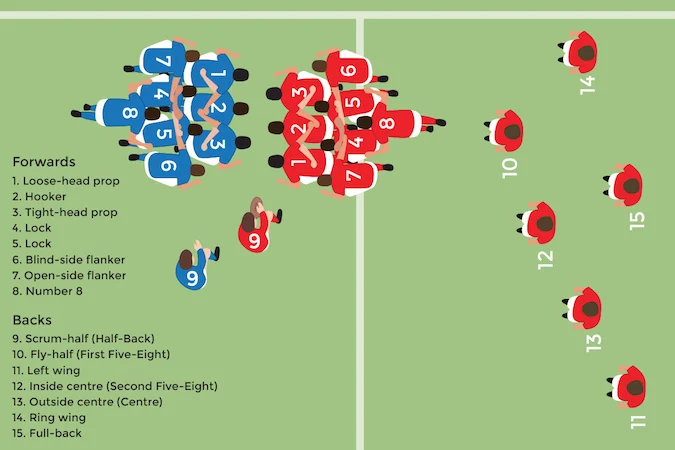
Each rugby position is identified by a jersey number from 1 to 15, which indicates the player’s role on the field. Numbers are not arbitrary; they provide a clear structure for positioning and responsibilities. Knowing the numbers associated with rugby positions helps players and spectators recognise who is performing specific tasks during set pieces and open play, ensuring smooth coordination across the team.
Forwards
Forwards form the engine room of a rugby team, providing the physical strength necessary to dominate scrums, secure ball possession, and win lineouts. Rugby positions in the forwards group include props, hooker, locks, flankers, and number eight. Each of these roles demands a combination of strength, stamina, and technical skill, making the forwards essential for establishing control in key areas of the field.
The front row, consisting of the loosehead prop, hooker, and tighthead prop, is critical in scrums. They provide stability and power, allowing the team to gain momentum. Locks, also known as second row players, use their height and strength to win lineouts and push effectively in scrums. Back row players, including flankers and number eight, link forwards with backs while securing the ball and tackling aggressively. Mastering these rugby positions is key to building a strong forward pack.
Backs

Backs are the team’s primary creators and scorers, relying on speed, agility, and tactical awareness. Rugby positions in the backs include scrum-half, fly-half, inside centre, outside centre, wings, and fullback. These positions require excellent decision-making, passing skills, and the ability to read the game quickly to exploit defensive weaknesses.
Scrum-halves act as the link between forwards and backs, distributing the ball accurately and guiding team attacks. Fly-halves are often the playmakers, controlling territory with tactical kicks and directing offensive moves. Centres use power and agility to break defensive lines, while wings are fast finishers who score tries from wide positions. Fullbacks act as the last line of defence, counter-attacking and fielding kicks, making them vital in both attack and defence. Understanding these rugby positions allows teams to execute fluid, coordinated gameplay.
Key Skills and Attributes by Position
Every rugby position demands specific physical, technical, and mental attributes. Strength, speed, agility, and endurance are critical for performing consistently across all positions. Players must master core skills such as tackling, passing, kicking, and strategic positioning to excel in their designated rugby positions.
Mental attributes are equally important in rugby positions. Communication, teamwork, resilience, and leadership are essential for players to perform under pressure. Understanding game patterns, anticipating opponents’ actions, and maintaining focus ensures that every rugby position contributes effectively to team strategy. By developing these skills, players can maximise their impact on the field and help their team succeed.
How Rugby Positions Work Together
Coordination between forwards and backs is fundamental in rugby, as each position supports the others to maintain possession and control. Forwards secure the ball in scrums, lineouts, and rucks, while backs use speed and skill to exploit opportunities, create space, and score tries. Each rugby position contributes to balanced team dynamics, ensuring cohesion during both offensive and defensive phases.
Set pieces, such as scrums, lineouts, and kick-offs, demonstrate the importance of rugby positions working in harmony. Players must understand their roles, positioning, and timing to achieve strategic objectives. Observing professional teams highlights how effective communication and coordinated execution of rugby positions can dominate possession, create scoring chances, and control the game’s tempo. Mastery of these interactions is key to high-level performance.
Common Mistakes to Avoid in Rugby Positions
Beginners often misunderstand the responsibilities of certain rugby positions, leading to gaps in defence or inefficient attacks. Forwards may neglect ball support, while backs can fail to anticipate defensive coverage. Awareness of each rugby position’s role prevents these mistakes and enhances overall team performance.
Another common error is underestimating the physical and mental demands of rugby positions. Each position requires endurance, skill, and tactical understanding. Neglecting proper training or positional awareness can result in lost opportunities and poor team cohesion. Focusing on both technical and strategic aspects ensures that all rugby positions function effectively.
Conclusion
Understanding rugby positions is essential for players, coaches, and fans seeking to appreciate the game fully. Each position, from the powerhouse forwards to the agile backs, plays a distinct role that impacts team performance. By studying rugby positions, beginners can improve skills, enjoy the sport more, and gain a deeper understanding of strategic gameplay.
Mastering rugby positions requires practice, observation, and dedication. Players who understand the nuances of each role contribute to a team’s success, while fans who grasp the positions can follow matches with greater insight. Ultimately, knowledge of rugby positions enriches both participation and enjoyment of this thrilling sport.
You may also read: Best Basketball Hoops Available in the UK