From Human Agents to AI: The Evolution of the Modern Contact Center
AI contact center solutions and call center software solutions have become essential tools for businesses that want to deliver fast, reliable, and personalized customer support. What used to be a simple phone-based operation has grown into a connected system powered by automation, data, and intelligent technologies.
Over time, customer expectations have shifted. People now want instant answers, seamless communication across channels, and support that feels both efficient and human. This demand has pushed companies to rethink how they approach customer service, leading to the rise of the modern ai contact center.
This article explores how contact centers have evolved—from traditional call handling to AI-powered experiences—and how businesses can benefit from adopting smarter, more flexible solutions.
The Dawn of Customer Support: The Traditional Call Center
The Era of PBX and Landlines
Customer support began with basic tools—phones, switchboards, and human agents handling every request. Early systems used PBX technology to route calls internally, but agents had little access to customer information. Most interactions relied on scripts and personal judgment.
These environments were often high-pressure. Agents worked continuously, answering calls with limited support. While effective for their time, these systems lacked flexibility and personalization, setting the stage for the future ai contact center.
Key Metrics: Focus on Efficiency
Traditional call centers measured success through metrics like Average Handle Time (AHT) and call volume. The goal was to resolve as many calls as possible, as quickly as possible.
While efficient, this approach often led to rushed conversations and unresolved issues. Customer satisfaction was secondary, highlighting a gap between speed and quality.
Limitations of Legacy Systems
Scaling required more space, hardware, and staff, making growth expensive. Support was limited to business hours, and service quality varied. These challenges revealed the need for a more scalable, flexible solution.
The Shift to the Omnichannel Contact Center
Breaking the Voice Barrier: Integrating Email, SMS, and Chat
As digital communication became more common, customers began expecting more than just phone support. Businesses responded by introducing email, SMS, and live chat into their customer service strategies. This shift marked the transition from single-channel communication to omnichannel engagement.
With multiple channels available, customers could choose how they wanted to interact. Whether sending an email, chatting online, or making a call, the experience became more convenient and accessible. This transformation was a key step toward building the modern ai contact center, where seamless communication is essential.
The Rise of the Cloud: Moving from On-Premise to CCaaS
Cloud technology changed how contact centers operate. Instead of relying on on-premise hardware, businesses began adopting Contact Center as a Service (CCaaS) solutions. These platforms allowed companies to run their operations in the cloud, reducing the need for physical infrastructure.
Cloud-based systems made it easier to scale, update, and manage contact centers. They also enabled remote work, allowing agents to provide support from virtually anywhere. This flexibility became especially important as businesses expanded globally and needed to support customers across different time zones.
Meeting the Modern Customer: The Demand for 24/7 Availability
Modern customers expect immediate support, regardless of the time or day. To meet these expectations, businesses began combining omnichannel communication with automation tools. Chatbots, self-service portals, and automated responses allowed companies to provide round-the-clock assistance.
This shift not only improved customer satisfaction but also reduced the pressure on human agents—setting the stage for the rise of the ai contact center.
Top AI Contact Center Companies and Brands to Consider
Choosing the right platform is essential for building a successful AI contact center. Here are some of the leading providers:
1. Bright Pattern – Intelligent Omnichannel AI Contact Center
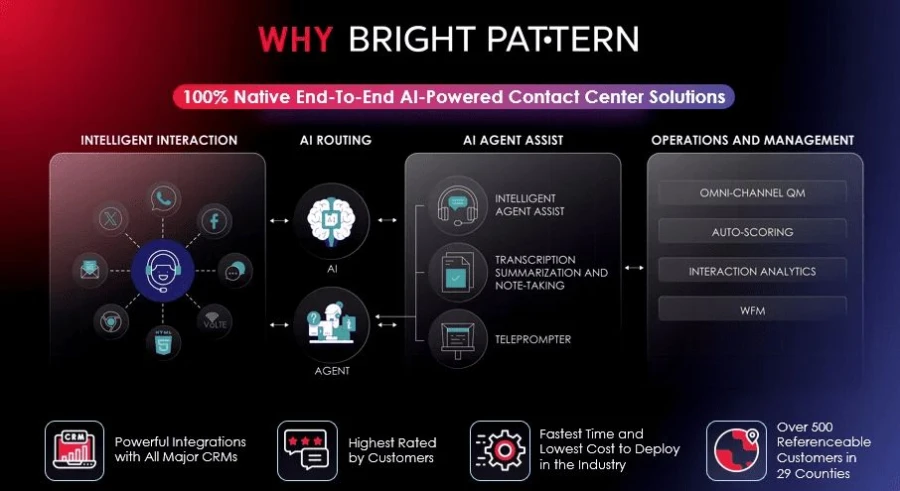
Bright Pattern stands out as a well-balanced solution that combines ease of use with advanced capabilities, making it suitable for both mid-sized businesses and large enterprises. Its AI contact center platform is designed to unify all communication channels—voice, chat, email, SMS, video, and social media—into a single, streamlined interface. This eliminates the need for multiple disconnected tools and allows agents to manage conversations more efficiently.
One of Bright Pattern’s strongest advantages is its true omnichannel approach. Customers can start a conversation on one channel and continue it on another without losing context. This creates a seamless experience that feels consistent and personalized.
The platform also includes powerful AI-driven features such as conversational AI for self-service, intelligent routing to connect customers with the right agents, and real-time agent assist tools that provide suggestions during live interactions. These capabilities help reduce wait times, improve first-contact resolution, and increase overall productivity.
Another key benefit is its fast deployment and flexibility. Unlike traditional systems that require complex setup, Bright Pattern can be implemented quickly and customized to fit different business needs. It also integrates easily with CRM systems and third-party applications, giving businesses a complete view of customer interactions.
In addition, Bright Pattern offers advanced analytics and reporting tools that provide insights into customer behavior, agent performance, and operational efficiency. These insights help organizations continuously improve their ai contact center strategy. Overall, Bright Pattern is a strong choice for companies looking for a modern, scalable, and user-friendly solution.
2. Genesys – Enterprise-Grade Experience Orchestration
Genesys delivers a scalable ai contact center solution with advanced routing, journey orchestration, and deep analytics, making it ideal for large enterprises with complex customer journeys.
3. Five9 – Cloud-Native AI Contact Center
Five9 focuses on automation and cloud-based support, offering tools such as virtual agents and predictive dialing to enhance productivity and customer experience.
4. Talkdesk – Automation-First Customer Experience
Talkdesk provides flexible and user-friendly ai contact center solutions with strong automation features and industry-specific customization options.
5. Zendesk – AI-Powered Support Made Simple
Zendesk combines simplicity with AI-driven tools like chatbots and automated workflows, making it a popular choice for growing businesses.
6. NICE – Advanced Analytics and Automation
NICE offers deep insights and analytics, helping businesses optimize their ai contact center performance with data-backed decisions.
7. Amazon Web Services (Amazon Connect) – Scalable AI Contact Center Infrastructure
Amazon Connect provides a flexible AI contact center built on AWS, enabling advanced AI integrations, scalability, and seamless connection with other cloud services.
The AI Contact Center Revolution: Defining the New Standard
What is an AI Contact Center?
An AI contact center combines automation, AI, and analytics to improve customer interactions. It uses tools like chatbots, voice assistants, and intelligent routing to deliver faster and more accurate support.
Unlike traditional systems, it continuously learns and improves, making it more efficient over time.
Conversational AI Replaces IVR
Old IVR systems required customers to follow rigid menus. Conversational AI allows natural communication, enabling users to speak or type freely. This creates a smoother, more intuitive experience.
Machine Learning and NLP
Machine learning and natural language processing help AI understand intent and context. Over time, these systems improve, handling more complex queries and reducing the need for human intervention.
Generative AI: The Catalyst for Hyper-Personalization
LLMs in Action: Automating Complex Customer Inquiries
Generative AI has introduced a new level of intelligence to the AI contact center. Large Language Models (LLMs) can handle multi-step conversations, provide detailed explanations, and guide users through complex processes.
This capability allows businesses to automate more interactions without sacrificing quality. Customers receive clear, helpful responses, even for more complicated issues.
From Scripts to Conversations: Enhancing Natural Language Understanding
One of the biggest improvements in the AI contact center is the shift from scripted replies to dynamic conversations. Instead of relying on predefined answers, AI systems can generate responses based on context.
This makes interactions feel more natural and engaging, improving the overall customer experience.
Reducing Friction: Using Generative AI for Real-Time Sentiment Analysis
Generative AI also enables real-time sentiment analysis. By evaluating tone and language, an AI contact center can detect whether a customer is frustrated, satisfied, or confused.
This insight allows the system to adjust responses, escalate issues when needed, and ensure that customers feel heard and understood.
The Augmented Agent: How AI Empowers Human Talent
AI Agent Assist: Real-Time Coaching and Knowledge Base Retrieval
AI doesn’t replace agents—it enhances their capabilities. In an AI contact center, agent assist tools provide real-time suggestions, relevant information, and step-by-step guidance during interactions.
This helps agents resolve issues faster and with greater confidence, improving both efficiency and service quality.
Automating the After-Call Work (ACW) with AI Summarization
After-call work (ACW) can take up a significant portion of an agent’s time. Tasks like writing summaries, updating records, and logging details are essential but repetitive.
AI automates these processes by generating summaries and updating systems instantly. This allows agents to focus on helping customers rather than handling administrative tasks.
Reducing Burnout: Letting AI Handle the Repetitive, High-Volume Tasks
High call volumes and repetitive inquiries can lead to agent burnout. By handling routine tasks, AI reduces workload and stress.
In an ai contact center, agents can focus on complex and meaningful interactions, leading to higher job satisfaction and better customer outcomes.
Measuring Success in the Era of AI Contact Center Automation
The Evolution of KPIs: From “Efficiency” to “Resolution and Empathy”
Success metrics have evolved alongside technology. While efficiency is still important, businesses now prioritize resolution, quality and customer satisfaction.
An AI contact center focuses on first-contact resolution, reduced effort, and positive customer experiences rather than just speed.
Tracking Customer Satisfaction (CSAT) in Automated Environments
Customer Satisfaction (CSAT) remains a critical metric. Even with automation, businesses must ensure their AI contact center meets customer expectations.
Surveys, feedback tools, and sentiment analysis help companies measure satisfaction and identify areas for improvement.
The ROI of AI: Cost Reduction vs. Lifetime Value (LTV)
Investing in an AI contact center delivers measurable returns. Automation reduces operational costs, while improved experiences increase customer retention and lifetime value (LTV).
This balance between efficiency and long-term growth makes AI a valuable investment for modern businesses.
The Future Landscape: What’s Next for AI in CX?
Predictive Support: Solving Problems Before the Customer Calls
The future of the AI contact center lies in prediction. By analyzing customer behavior and historical data, AI can anticipate issues before they occur.
This proactive approach reduces support requests and enhances customer satisfaction.
The Convergence of CRM and AI for a 360-Degree View
Integrating AI with customer relationship management (CRM) systems creates a complete view of each customer. This enables more personalized interactions and smarter decision-making.
An AI contact center powered by unified data can deliver consistent and relevant experiences across all touchpoints.
Ethical AI: Balancing Automation with the Human Touch
As AI becomes more advanced, ethical considerations become more important. Businesses must ensure transparency, protect customer data, and maintain a human element in their ai contact center.
Balancing automation with empathy is key to building trust and long-term relationships.
Conclusion
The journey from traditional call centers to the modern ai contact center highlights a major shift in how businesses approach customer support. What once relied entirely on human effort has become a blend of human expertise and intelligent automation.
An AI contact center doesn’t replace people—it empowers them. By handling routine tasks and providing real-time insights, AI allows agents to focus on what matters most: delivering meaningful, empathetic customer experiences.
As customer expectations continue to grow, businesses that invest in AI contact center solutions and advanced call center software solutions will be better positioned to deliver exceptional service, build lasting relationships, and stay competitive in an increasingly digital world.